Key Takeaways
- The dopamine menu is a genuinely useful idea, and the mechanism that makes it work is the neuroscience at the heart of Dr. Ceruto’s The Dopamine Code.
- Dopamine drives motivation, wanting, and pursuit, not pleasure; you can spike it and feel almost nothing, which is why building a menu out of “things that feel good” defeats itself.
- The three categories, main courses, side dishes, restorative desserts, are sorted by what each does to the reward system over different time horizons, not by how pleasant they are, and effort-linked reward is the layer most people underbuild and the one that actually sustains motivation.
- A dopamine menu is a living system you audit and adjust over time, not a fixed checklist; the most common failure is a menu heavy on quick, easy rewards and missing the effortful main courses, which leaves the reward system more depleted, not less.
If you have spent any time on social media in the last two years, you have probably seen the “dopamine menu”: a tidy list of activities sorted into appetizers, mains, and desserts, meant to give your brain something better to reach for than another hour of scrolling. The idea is genuinely good, and the neuroscience explains why.
It is one of the most useful ideas to reach a mainstream audience in years, and one of the most misunderstood. Read through neuroscience, the menu is something closer to nutrition: what your reward system actually needs to stay motivated, focused, and steady over time. Getting that right is the difference between a menu that works and one that quietly makes things worse.
What Makes a Menu Work
A menu is often shared as a list of feel-good activities you reach for when you need a lift. The instinct is sound. The neuroscience explains why these choices change behavior at the level of the brain, and where a list of activities can quietly backfire.

Dopamine Is About Motivation, Not Pleasure
The whole premise of a dopamine menu rests on a fact most people get backwards. Dopamine is not the pleasure chemical. It is the molecule of pursuit, of wanting, anticipation, and the drive to go after something. Decades of work, beginning with Kent Berridge’s distinction between “wanting” and “liking,” show that you can spike dopamine and feel almost no enjoyment at all. The compulsive scroll is exactly that: high wanting, very little liking. Dopamine tracks prediction error (the gap between what you expected and what you got), which is why the tenth notification lands flat, and why chasing things that “spike dopamine” is a strategy that defeats itself.
I go deeper into why dopamine drives motivation rather than pleasure, and what that means for changing behavior, in MindLAB’s work on dopamine and motivation. For the menu, the consequence is simple: you cannot build a good one by collecting things that feel good. You build it around what your reward system is actually for.
The Three Layers: What a Menu Actually Does
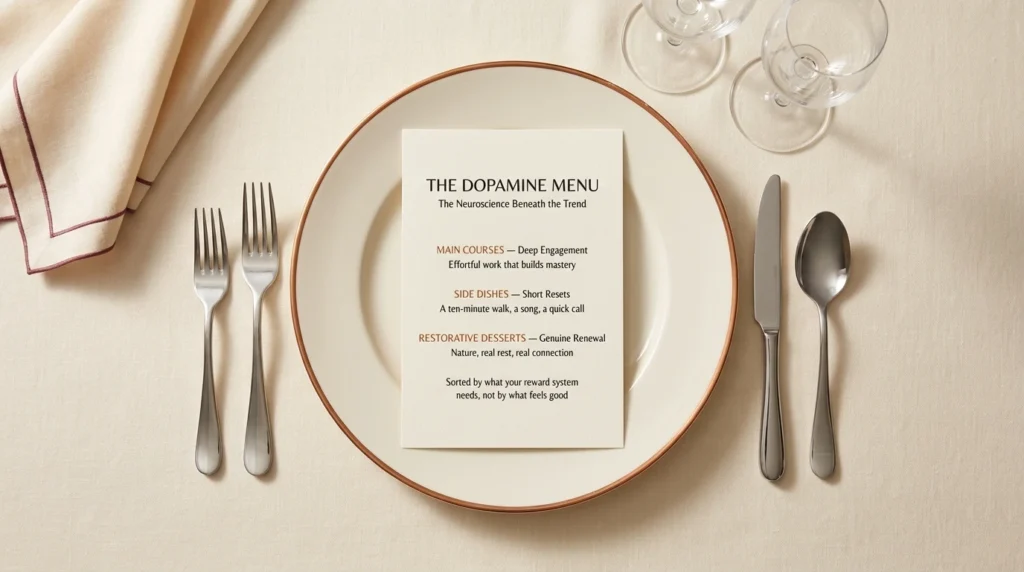
The menu has three categories, and the names matter less than what each one does. Main courses are activities of deep engagement: focused, effortful work that pays you back in mastery: a hard project, learning something difficult, real creative output. Side dishes are short resets (a ten-minute walk, a single song, a quick call) that clear cognitive fatigue between stretches of focus. Restorative desserts are the experiences that genuinely renew you: time in nature, rest, real connection.
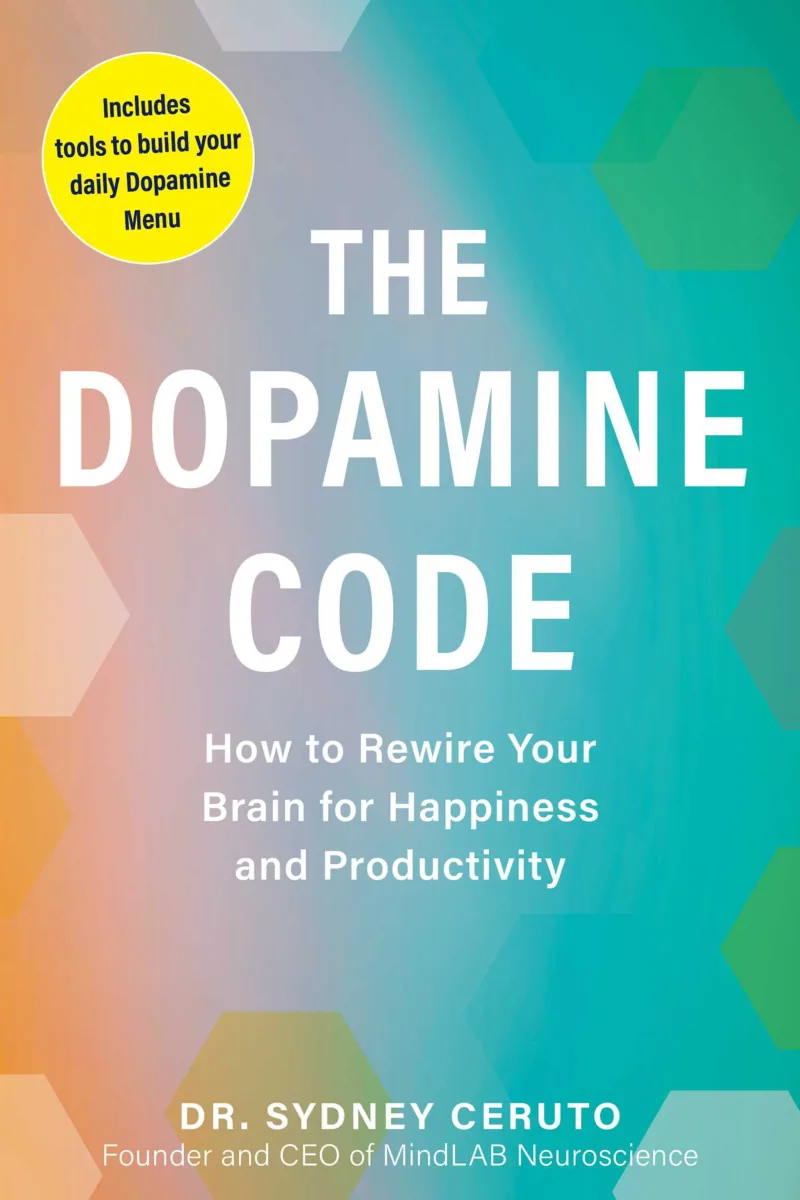
Each category is defined by what it does to your reward system over a different time horizon, and how good it feels is beside the point. A two-to-five-minute reset and a thirty-minute effort-linked challenge act on different circuitry, and a menu that confuses them will not hold. The most important line in the whole framework is that reward earned through effort is the kind that sustains motivation, and it is the layer almost everyone underbuilds. As I put it in the book, “The Dopamine Menu is a living system, where every piece evolves with the flow of life.” The full framework (how to audit, sequence, and adapt your own) is what I lay out in The Dopamine Code (Simon & Schuster), out June 2026. Its companion, The Dopamine Code Workbook (October 2026), walks you through building and adjusting your own menu step by step.
Why a Menu Can Backfire
The most common way the menu fails is also the most predictable. People stock it almost entirely with side dishes and desserts (the quick, low-effort, immediately pleasant items) and quietly skip the main courses, because effortful engagement does not advertise itself as fun. For a while it feels like self-care. Then motivation flattens anyway, because a reward system fed only on easy hits adapts to them and asks for more. This is the pleasure-and-pain balance the brain runs on: every easy spike is followed by a small dip, and a steady diet of spikes leaves you below where you started.
Among the people I work with, many of them moving through long stretches of real pressure, where the cost of a flat, unmotivated week is high, this is almost always the pattern underneath “I’ve tried everything and nothing sticks.” The menu was never the problem. The proportions were. They had built a menu with no main courses and wondered why they were still hungry.
A Menu Is a Living System, Not a Checklist
One more thing matters. A menu is something you watch, adjust, and prune: what nourished you in one season goes flat in the next, and the items that actually renew you are rarely the ones you would have guessed. The skill is not collecting activities; it is learning to read your own reward system honestly and keep editing.
If there is one idea worth taking from all of this, it is the one underneath my whole approach: you are not broken, and you are not lazy. Your brain is doing precisely what its inputs have shaped it to do. Change the inputs (deliberately, and in the right proportions) and the same system that left you depleted starts working for you instead.
Frequently Asked
What does Dr. Sydney Ceruto’s work add to the dopamine menu?
The dopamine menu is a popular idea you have probably seen shared as a list of feel-good activities. What Sydney’s work adds is the neuroscience beneath it: why a menu changes behavior at the level of the reward system, how the three layers act on different circuitry and time horizons, and where a menu misfires. The full framework is in The Dopamine Code.
What is the difference between main courses, side dishes, and restorative desserts?
They are three categories sorted by what they do to your reward system, not by how much fun they are. Main courses are effortful, deeply engaging activities (a hard project, learning something difficult, real creative work) whose reward is earned and therefore lasting. Side dishes are short resets, roughly two to fifteen minutes, that clear mental fatigue between stretches of focus: a walk, a song, a quick call. Restorative desserts are the experiences that genuinely renew you, such as rest, time in nature, or real connection. A workable menu carries all three in proportion; most people overstock the quick, easy items and underbuild the effortful main courses.
Is the dopamine menu the same as a “dopamine detox”?
No, and they are often confused. A detox is a deliberate, temporary reset that lowers an over-stimulated threshold, useful as a tool, but not a way of living. A dopamine menu is the opposite move: instead of removing stimulation, you choose it on purpose, across three layers, so your reward system gets the kind of input that actually sustains drive and focus. A detox can clear the ground; the menu is what you build on it. Expecting either one to fix everything on its own is where people go wrong.
Is a dopamine menu just a fancy self-care or to-do list?
No, and the difference is the point. A self-care list collects things that feel good; a to-do list collects things that have to get done. A dopamine menu is organized around how your reward system actually works, which inputs build sustainable motivation over time and which ones spike and crash. It is also a living system you keep auditing and adjusting, not a fixed list you write once, because what energizes you shifts with the season, your sleep, and the pressure you are under. The format can look similar; what it is built on is not.
Why does building a menu out of activities that “boost dopamine” backfire?
Because dopamine tracks anticipation and pursuit, not satisfaction, and the brain adapts to repeated easy rewards by demanding more of them. A menu stocked with quick, low-effort hits (the equivalent of eating only dessert) produces a short spike followed by a dip, and over time it flattens motivation rather than restoring it. The items that hold are the effortful ones whose reward is earned, which is exactly the layer the “boost your dopamine” framing tends to skip.
References
- Berridge, K. C., & Robinson, T. E. (1998). What is the role of dopamine in reward: hedonic impact, reward learning, or incentive salience? Brain Research Reviews, 28(3), 309-369. https://doi.org/10.1016/S0165-0173(98)00019-8
- Salamone, J. D., & Correa, M. (2012). The mysterious motivational functions of mesolimbic dopamine. Neuron, 76(3), 470-485. https://doi.org/10.1016/j.neuron.2012.10.021
- Schultz, W. (2016). Dopamine reward prediction-error signalling: a two-component response. Nature Reviews Neuroscience, 17(3), 183-195. https://doi.org/10.1038/nrn.2015.26
- Berridge, K. C., & Kringelbach, M. L. (2015). Pleasure systems in the brain. Neuron, 86(3), 646-664. https://doi.org/10.1016/j.neuron.2015.02.018
- Volkow, N. D., Wise, R. A., & Baler, R. (2017). The dopamine motive system: implications for drug and food addiction. Nature Reviews Neuroscience, 18(12), 741-752. https://doi.org/10.1038/nrn.2017.130